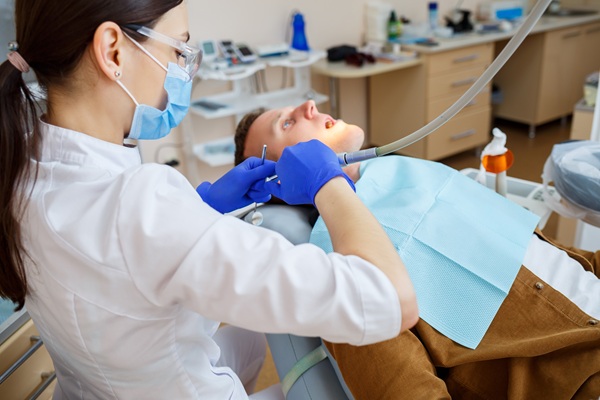
A general dentist does more than routine dental treatments like teeth cleanings during checkups. They also screen their patients for issues like oral cancer. Cancer is an out-of-control growth of cells that invade and damage healthy tissues around them. Oral cancer typically manifests as a sore or growth that develops in the mouth that does not go away. It includes cancers of the cheeks, tongue, lips, palates, throat, and sinuses.
Healthcare professionals have been unable to come to a consensus regarding how often people should be screened for oral cancer, but people who have a higher risk of developing it should get screened as often as they can.
Factors that can increase a person’s risk of developing oral cancer include:
- Habitual use of tobacco products like chewing dip and cigarettes
- People who regularly consume excessive amounts of alcohol
- People who have had oral cancer in the past
- People with certain types of human papillomavirus
- People who spend lots of time in the sun
A general dentist explains how oral cancer screening works
There are different levels of oral cancer tests a general dentist performs. A basic oral cancer screen includes examining parts of the body like the lips, tongue, gums, cheeks, throat, and palate. The dentist might insert a finger underneath the patient’s tongue to feel the skin underneath the chin and other soft tissues in the mouth looking for abnormal growths. A basic oral cancer screen only takes about five minutes.
The goal of such screens is to search for spots and lumps and anything else unusual in the patient’s mouth. People who notice any unusual growths in their mouths are advised to see a dentist or other healthcare professional immediately.
The dentist might perform a more detailed test by rinsing the patient’s mouth with a blue die prior to the examination. Any unusual cells in the mouth absorb the dye, making them easier to spot.
What goes on if oral cancer is detected
If a dentist notices anything unusual while performing an oral cancer screen, the patient might be scheduled for a follow-up appointment in a few weeks to see if anything changes. The dentist might also recommend a biopsy. This involves taking a small piece of tissue from the area in question and sending it to a lab to search for cancer cells. The dentist might extract the tissue by themselves or refer the patient to a doctor.
It should be noted that not all lumps or spots that are detected during oral cancer screens turn out to be cancerous. However, catching cancer in its early stages gives patients more treatment options. Biannual dental checkups increase the odds of oral cancer being detected early.
Get screened asap
Oral cancer is a lot easier to treat when detected early, yet it can be life-threatening when it progresses to its advanced stages. Give us a call or stop by our Houston clinic to set up an appointment with our dentist.
Request an appointment here: https://www.smilesbycanada.com or call Smiles by Dr. Canada at (281) 826-5180 for an appointment in our Houston office.
Check out what others are saying about our dental services on Yelp: Oral Cancer in Houston, TX.
Recent Posts
Oral cancer screenings are a simple yet essential procedure that helps dentists look for signs of cancer in your mouth and throat. This quick and painless examination can catch signs of oral cancer in its early stages. If you have an upcoming oral cancer screening, here is what you can expect from the process.An oral…
During a dental visit, it would be a good idea to get an oral cancer screening to see if you are at risk of developing oral cancer. According to the National Institutes of Health (NIH), about 49,700 people in the United States are diagnosed with oral cancer every year. Getting screened for this disease will…
Since some of the warning signs associated with oral cancer can be confused with other less serious dental problems, it is important for patients to learn more about the warning signs of oral cancer. Understanding the signs can help you determine whether or not the symptoms you are currently experiencing are indeed cancer-related. You can…
An oral cancer screening is usually part of a routine general dentistry check-up visit. They become necessary once a person reaches the age of 45. The screening itself is very easy and does not involve pain or discomfort on the patient's end. The dentist will touch the inner tissues of the oral cavity and examine…